


Unlock flavor: creative ways to use Thai red curry paste

TL;DR:
Thai red curry paste is versatile and can be used in many dishes beyond traditional curries.
Proper technique, like frying the paste and balancing flavors, is key to authentic tasting results.
Store leftovers properly and experiment freely, adjusting ingredients and seasonings as needed.
That little jar of Thai red curry paste sitting in the back of your fridge has more potential than you think. Most home cooks buy it for one dish, maybe a classic coconut curry on a Tuesday night, then forget about it for weeks. The paste dries out, loses its punch, and eventually gets tossed. It’s a real shame, because Thai red curry paste is one of the most flavor-packed, versatile ingredients you can keep in your kitchen. This guide will show you exactly how to use it across a wide range of dishes, help you fix common mistakes, and give you the confidence to cook with it every single week.
Table of Contents
Key Takeaways
Point | Details |
Frying activates flavor | Always fry Thai red curry paste in oil or coconut cream to release its best taste and aroma. |
Versatile in many dishes | Red curry paste transforms soups, stir-fries, sauces, salads, and marinades beyond classic curries. |
Balance seasoning for authenticity | Achieve the signature Thai balance by tasting and adjusting seasoning as you cook. |
Store and adapt confidently | Red curry paste keeps well refrigerated or frozen, and can be easily adapted for vegan or allergy-friendly cooking. |
Understanding Thai red curry paste: Basics and essentials
Before you start cooking, it helps to understand what you’re working with. What is curry paste? At its core, Thai red curry paste is a concentrated blend of dried red chilies, lemongrass, galangal (a relative of ginger with a more citrusy bite), kaffir lime zest, shrimp paste, garlic, and shallots. Every ingredient plays a specific role in building flavor.
The color comes primarily from the dried red chilies, but heat level varies depending on the variety used. Thai bird’s eye chilies hit hard and fast. Guajillo or New Mexico chilies give color with milder warmth. Knowing this helps you choose the right brand for your heat tolerance.
What makes red curry paste taste authentic?
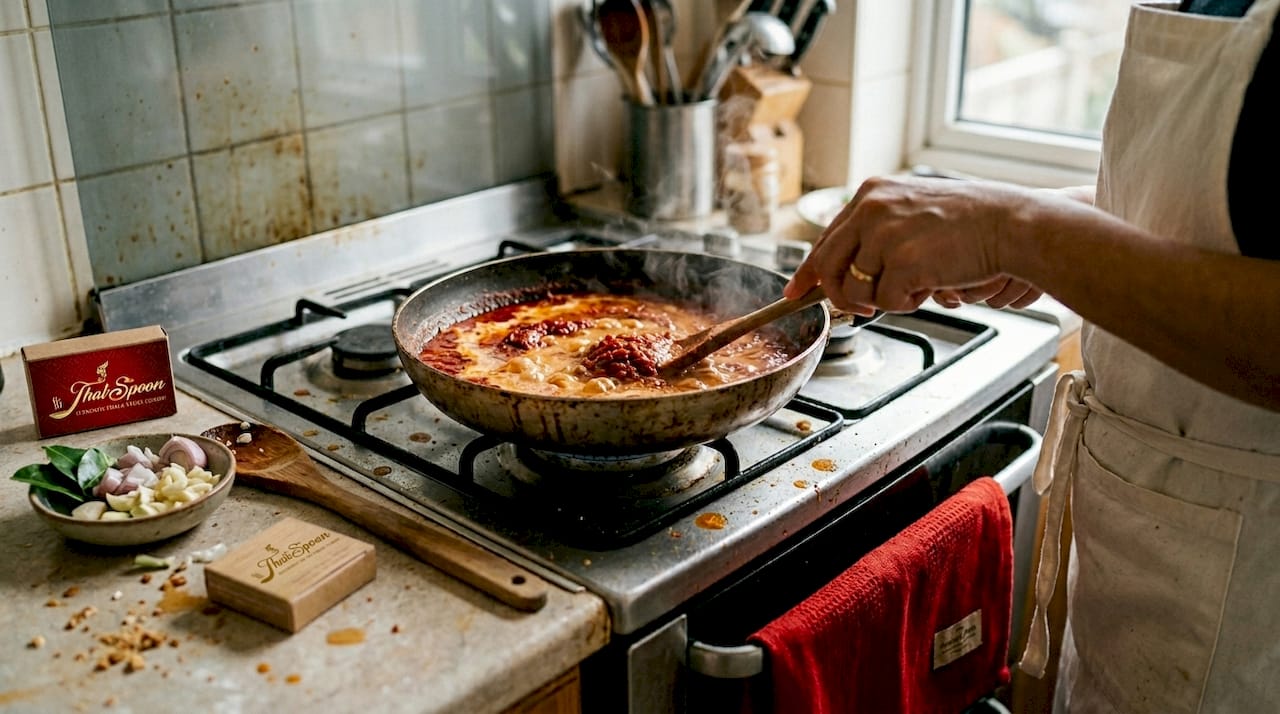
Here’s the most important cooking tip you’ll read today. Always fry your paste first in oil or thick coconut cream for 2 to 3 minutes before adding any liquid. This step, called “blooming,” unlocks the fat-soluble flavor compounds in the chilies and aromatics. You’ll know it’s ready when the oil starts to separate and the kitchen smells incredible. Skipping this step is the number one reason homemade Thai curries taste flat and watery.
Ingredient | Role in paste | Notes |
Dried red chilies | Heat and color | Quantity controls spice level |
Lemongrass | Floral, citrus brightness | Bruise before blending |
Galangal | Earthy, piney depth | Different from ginger |
Shrimp paste | Umami backbone | Sub with miso for vegan |
Kaffir lime zest | Aromatic lift | Freeze extra leaves/zest |
Garlic and shallots | Savory base | Fresh always better |
Traditional Thai cooks use a granite mortar and pestle, grinding wet and dry ingredients in a specific order to build a smooth, deeply aromatic paste. For home cooks, a high-speed blender works fine, especially for tougher ingredients like lemongrass. The key is adding just enough water to get things moving without diluting the paste too much.
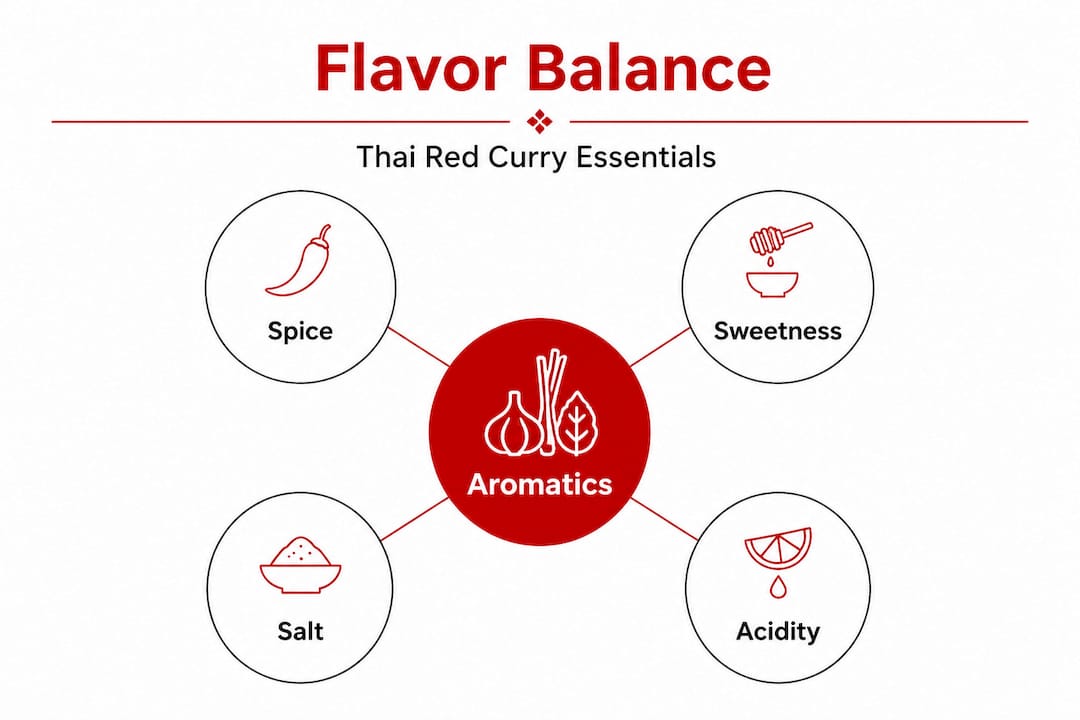
For the essential Thai ingredients every cook should have on hand, fish sauce, palm sugar, and lime juice round out the flavor profile. Thai cooking revolves around balancing four sensations: hot, sour, salty, and sweet. When one feels off, adjusting another can fix the whole dish.
Key flavor builders for red curry paste:
Fish sauce for salt and umami depth
Palm sugar or light brown sugar for gentle sweetness
Fresh lime juice or tamarind for sourness
Fresh or dried chilies for variable heat
Pro Tip: Taste your paste right out of the jar before cooking. Some brands are far saltier than others, which means you’ll need less fish sauce later. Starting with a small taste saves you from overseasoning the whole dish.
Step-by-step: Classic Thai red curry and beyond
Now that you know what goes into red curry paste, let’s apply it to both classic and creative dishes.
The classic approach is still the best starting point. Thai red curry is traditionally made by frying the paste in thick coconut cream until fragrant and the oil separates, then adding coconut milk, your protein of choice (chicken, shrimp, tofu), and vegetables like pumpkin, green beans, or Thai eggplant. The process takes about 20 to 25 minutes from start to finish.
Steps for classic Thai red curry
Heat a tablespoon of oil or the thick top layer of canned coconut cream in a wok or wide pan over medium-high heat.
Add 2 to 3 tablespoons of red curry paste and fry, stirring constantly, for 2 to 3 minutes until fragrant and oil separates.
Pour in one 13.5 oz can of coconut milk and stir to combine.
Add your protein and bring to a gentle simmer. For chicken breast, 10 to 12 minutes is enough.
Toss in vegetables that need less time, like green beans or zucchini, in the last 5 minutes.
Season with fish sauce, palm sugar, and a squeeze of lime juice. Taste and adjust.
Finish with fresh Thai basil leaves and sliced red chili for color.
Beyond the classic curry
This is where things get exciting. Red curry paste works beautifully as the flavor base for Khao Soi, a rich Northern Thai noodle soup topped with crispy fried noodles. It can also anchor Panang and Massaman curries when you add the right additional spices like cumin, coriander, or peanuts. Beyond curries, it works in stir-fries, satay dipping sauce, salad dressings, sausage seasoning, and even marinades for grilled meats.
Curious about the full range of Thai curry styles? The types of Thai curries guide covers the differences between red, green, yellow, Massaman, and Panang in detail.
Dish | How red curry paste is used | Add-ons needed |
Classic red curry | Base, fried in coconut cream | Coconut milk, protein, veg |
Khao Soi noodle soup | Soup broth base | Egg noodles, broth, toppings |
Stir-fry sauce | Mixed with oyster sauce | Vegetables, protein |
Satay dipping sauce | Blended with peanut butter | Coconut milk, lime, sugar |
Salad dressing | Thinned with lime and oil | Herbs, shredded vegetables |
Marinade for grilled meats | Rubbed directly onto protein | Coconut milk, garlic |
For more weeknight inspiration, the Thai dinner ideas collection is a great place to look when you’re not sure what to make.
Pro Tip: When using red curry paste in stir-fries, reduce the amount by about half compared to what you’d use for a curry. The concentrated heat from direct pan frying is much more intense without liquid to mellow it out.
Perfecting flavor balance: Aromatics, spice, and seasoning tips
With your dishes underway, mastering flavor balance takes your cooking from good to great.
One honest truth about store-bought paste: it often lacks freshness. Even quality brands like Mae Ploy and Maesri lose some of their bright, herbal character after processing. The fix is simple. Before frying, stir in a teaspoon of finely grated fresh ginger, a clove of minced garlic, and a tablespoon of finely minced lemongrass. These aromatics wake everything back up.
The balance in Thai flavors is not a formula. It’s a feel. Every brand of curry paste has a different salt level, a different heat profile, and a different ratio of aromatics. Brand variance means you simply cannot rely on fixed measurements. You have to taste as you go, adjust slowly, and trust your palate.
How to use Thai spices confidently
When you understand how to use Thai spices, seasoning stops feeling like guesswork. The basic framework is:
Salty: Fish sauce added in small splashes, tasting after each addition
Sweet: A small pinch of palm sugar at a time, dissolved fully before retasting
Sour: Fresh lime juice squeezed in at the end of cooking, not during simmering
Hot: Controlled by the amount of paste or by adding fresh chilies separately
“The goal in Thai cooking is never to taste one element above the others. When the dish is balanced, you taste everything at once and nothing individually stands out. That’s the mark of a well-seasoned Thai dish.”
Understanding the Thai taste profile helps home cooks stop chasing a single flavor and start thinking about the whole dish. If your curry tastes flat, it likely needs both salt and acid, not just one or the other. If it tastes harsh, a small amount of sugar softens the edges without making it sweet.
Vegan and gluten-free substitutions that actually work:
Swap fish sauce for soy sauce or tamari (use a bit less, as soy is often saltier)
Replace shrimp paste in homemade paste with white miso
Choose brands labeled vegan, such as Maesri vegetarian red curry paste
Check for gluten in soy-based additions and use certified gluten-free soy sauce
Troubleshooting, storage, and making adaptations for dietary needs
Even with best practices, adaptations and troubleshooting help you use paste confidently whenever and however you want.
Storing your curry paste the right way
Opened red curry paste should be refrigerated immediately and can last up to 6 months when properly stored. Unopened, a pantry-stored jar stays good for around 2 years. For longer preservation, freeze paste in ice cube trays or small portions and keep frozen for up to 1 year. Always press plastic wrap against the surface of any remaining paste in the jar, or pour a thin layer of oil over it to prevent drying and oxidation.
Common mistakes and how to fix them
Grainy or broken sauce: This usually happens from boiling the curry too hard after adding coconut milk. Keep heat at a gentle simmer and stir occasionally.
Bland flavor: The paste wasn’t fried long enough. If your curry tastes flat, add a bit more paste, fry it separately, and stir it back in.
Too spicy: Stir in a bit more coconut milk, a small spoon of sugar, and a squeeze of lime. Dairy like plain yogurt also cuts heat in a pinch.
Thin, watery sauce: Simmer uncovered for a few extra minutes to reduce and thicken. A tablespoon of peanut butter also adds body.
Overcooked protein: Add seafood in the last 3 to 4 minutes. Chicken thighs are more forgiving than breast. Tofu can go in earlier since it just absorbs flavor.
Dietary modifications that work
Vegan adaptations are straightforward with the right swaps. Use miso paste or soy sauce in place of shrimp paste and fish sauce. Load up on tofu, tempeh, or lentils for protein, and add extra vegetables like sweet potato, broccoli, and baby corn.
Common problem | Likely cause | Quick fix |
Grainy sauce | Overboiling | Lower heat, stir gently |
Bland taste | Insufficient frying | Fry more paste separately |
Too spicy | Brand too hot | Add coconut milk and sugar |
Watery sauce | Low fat coconut milk | Simmer to reduce |
Rubbery shrimp | Added too early | Add seafood last |
For those exploring allergy-friendly Thai dishes in Las Vegas, knowing these substitutions in advance makes dining out or cooking at home far less stressful.
Pro Tip: Freeze curry paste in tablespoon-sized portions using an ice cube tray. Once solid, pop them into a sealed freezer bag. You’ll always have the exact amount you need without thawing the whole batch.
Why experimentation matters: What Thai home cooks can teach us
Here is an opinion worth sharing: the fear of doing it wrong holds more home cooks back from great Thai food than any missing ingredient ever has.
Authentic Thai home cooks use store-bought paste regularly. Homemade paste is wonderful, and if you have the time and ingredients, absolutely try it. But the idea that you need to make everything from scratch to cook “real” Thai food is simply not how it works in Thai kitchens. Practicality is baked into the cuisine. Thai cooks taste, adjust, improvise, and move on.
The most important shift you can make is treating store-bought paste as a flexible starting point rather than a fixed recipe. Add what you have. Swap what you don’t. Taste continuously throughout cooking. A good curry built on a store-bought paste with fresh aromatics and careful seasoning beats a technically perfect paste that was cooked poorly every single time.
The Thai chili paste guide explores another iconic Thai paste that follows the same principle. Multiple versions exist, all of them valid, all of them starting from a simple base and adjusting to context.
What Thai cooking really rewards is attentiveness. Stay close to your wok. Taste early and often. Adjust one thing at a time. That’s the actual method behind the flavor, and no amount of premium ingredients replaces it.
Bring authentic Thai flavors home with Thai Spoon Las Vegas
If this guide has sparked your appetite for real Thai cooking, you’re in good company. At Thai Spoon Las Vegas, we cook these flavors every day in our northwest Las Vegas kitchen, using recipes and techniques rooted in authentic Thai tradition.
[
Whether you want to taste a benchmark dish before recreating it at home or you’re looking for a reliable local spot to satisfy a curry craving, our full menu covers everything from classic red curry to Pad Thai, yellow curry, and steak fried rice. We also offer vegan and gluten-free options for every dietary need. Planning a larger event or get-together? Our catering services bring the same authentic flavors to your table at scale. Come taste what the right curry paste, cooked with care, can actually do.
Frequently asked questions
Can I use Thai red curry paste in non-traditional recipes?
Yes. Red curry paste works in soups, stir-fries, salad dressings, marinades, and even as seasoning for roasted vegetables, making it far more useful than its name suggests.
How do I make store-bought curry paste taste fresher?
Finely chop fresh ginger, garlic, and lemongrass, then fry them together with the paste in oil before adding any liquid. This simple step restores much of the brightness lost in processing.
What is the best way to store red curry paste for maximum shelf life?
Refrigerate after opening with a layer of oil or plastic pressed against the surface, and freeze in portions using an ice cube tray for up to one year of preserved freshness.
How can I make Thai red curry gluten-free or vegan?
Swap shrimp paste and fish sauce with white miso and certified gluten-free soy sauce or tamari, and select brands that are labeled vegan-friendly.
What can I do if my curry sauce turns grainy?
Lower your heat immediately and stir gently. Gently simmering rather than boiling keeps the emulsion stable and the sauce silky and smooth.
Recommended
https://casinobankidfritt.com is the resource that pointed me here, and I love that your post encourages experimenting instead of sticking to the one classic curry. The bit about frying the paste and tasting as you go feels like a real kitchen lesson — thanks for the confidence to use that jar more often.